Research Statement
I am interested in the life history traits of insects. Among them, I want to understand how the investment into reproduction affects the lifespan and senescence of organisms. For the last few years, I have been working with the ant species Cardiocondyla obscurior, a polygynous ant species with queens showing an increase in sexual production at the end of life, and a delay in the onset of senescence.
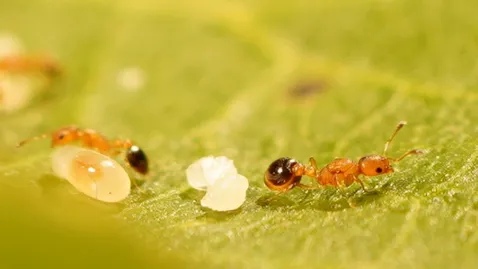
This delayed senescence is further supported by the findings: genes with middle-aged-biased expression are under stronger purifying selection compared to younger-biased genes (Harrison et al, 2021); transcriptional changes with age seem to appear only a few weeks before death which coincide with reproductive senescence (Jaimes-Nino et al, 2022); and there is no evidence of negative effects on offspring fitness due to advanced maternal age (Jaimes-Nino & Oettler, 2025).
Do all ant colonies follow this pattern?
Current Projects
Ageing and Gene-evolution in ants
When organisms age, the strength of selection against traits associated with senescence declines. This weakening, also known as the selection shadow, can be quantified genetically by measuring the strength of purifying selection acting on protein-coding genes with age-biased expression. The PhD student Lukas Franke will identify tissues and cell types that exhibit age-conserved expression patterns, as well as those that fall under the “selection shadow,” where selection against senescence weakens.
The Colony Ontogeny
I also want to understand why and how ant colonies decide to reproduce at a particular time. Is there some form of optimization involved? Do they respond to feedback mechanisms related to colony growth? To investigate this, I color-wire age-controlled queens and observe whether they remain in the colony or disperse to newly formed colonies. We study the timing of sexual production and dispersal in superorganismal colonies using a mixture of modelling and empirical approaches.
Ant Cognition and Navigation
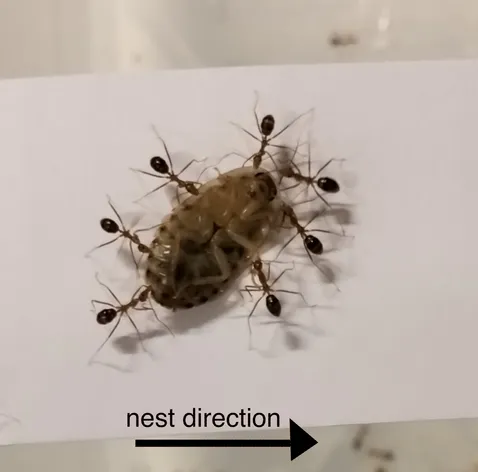
During my postdoc at the JGU, I also explore the molecular basis of complex behavioural traits such as cooperative transport, learning and rescue in other fascinating ants as Cataglyphis niger and Anoplolepis gracilipes.
Research Impact
My research showed that delayed actuarial senescence is not exclusive of Cardiocondyla obscurior but also occurs in seed-harvester ants and a termite. These findings led us to propose the reproductive strategy “continuusparity”: the repeated reproduction of an organism (queens) while maintaining the strength of selection against senescence after sexual maturation due to late-life fitness gains. This strategy may be unique to social organisms and has important implications for extending the healthspan of reproductives; an area previously unexplored in social insect studies. My work has opened new research avenues, including reproductive death and colony-level senescence in superorganisms, which I am currently pursuing.